


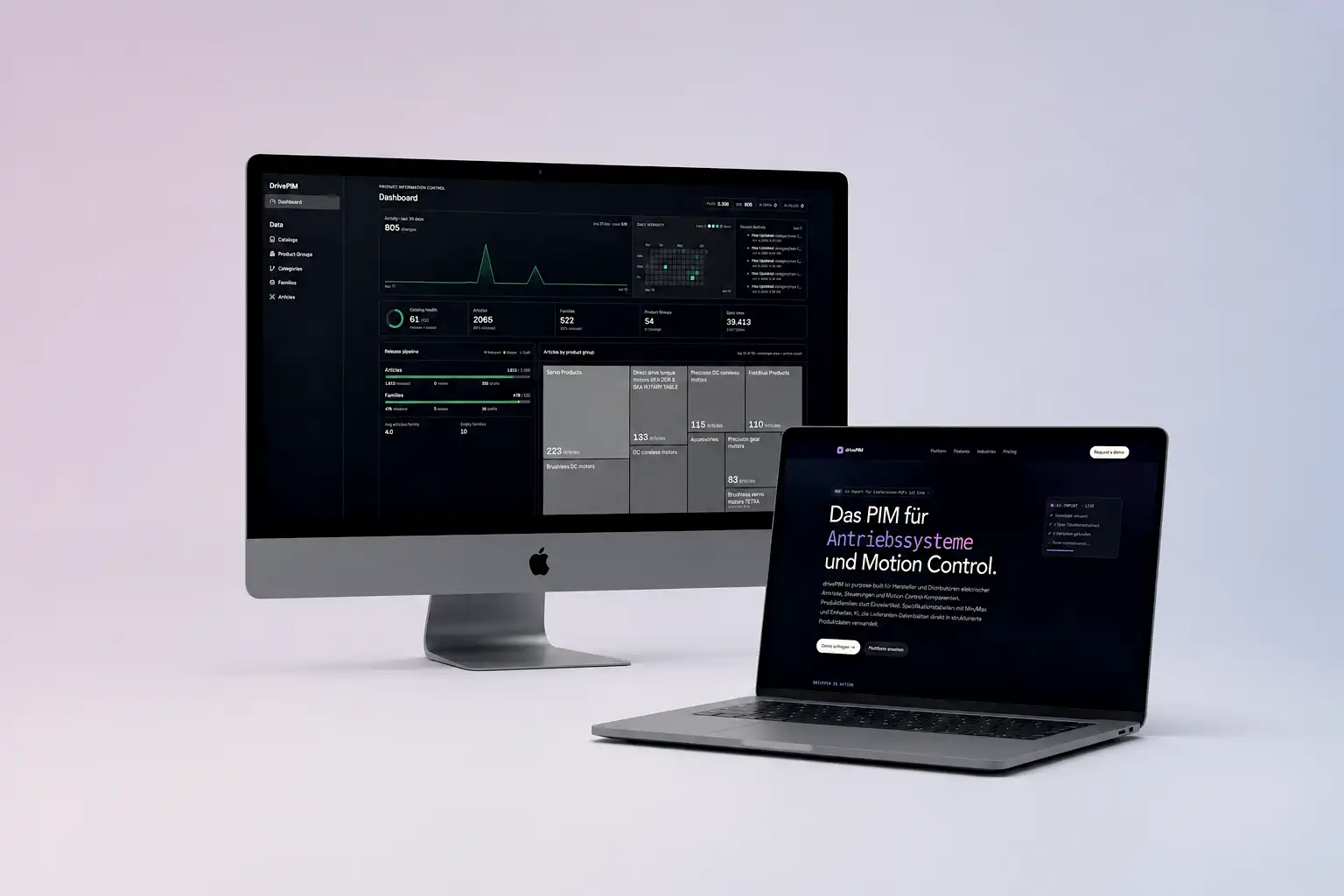
Product Information Manager for drive technology
Loehn Digital developed drivePIM — a fully custom Product Information Manager application — for and in collaboration with KOCO MOTION.
Unlike generic PIM solutions, drivePIM is designed from the ground up for manufacturers and distributors of electric drives and solves one of the industry’s most persistent problems: product data scattered across supplier PDFs, data sheets, Excel spreadsheets and websites is structured, normalised and managed centrally — with AI support, real-time reporting and an API-first architecture.
Starting point: data chaos between engineering and sales
KOCO MOTION is a systems house for electric drives and motion-control solutions — an explanation-intensive portfolio with dozens of motor types, thousands of variants and complex specification tables. Every motor has technical parameters such as torque, speed, voltage and dimensions, often with min/max ranges, tolerances and dependent conditions.
Existing PIM solutions on the market are built for fashion, FMCG and simple SKU structures — not for technical assortments where a product is not just a row with image and price, but a family of variants, specification tables and characteristic curves. The result: product data was maintained manually across multiple systems, supplier data sheets had to be transcribed by hand, and specifications were inconsistent.
The idea for drivePIM emerged from this daily challenge — and was realised together with KOCO MOTION as development partner.
The solution: a PIM platform built around drive technology as core logic
Loehn Digital developed drivePIM as a full-stack application with a FastAPI backend and SvelteKit frontend, REST API interface and a data model that accurately reflects the reality of technical product data.
Data model: five levels for complex assortments
Catalogue → Product group → Category → Family → Article
Editorial content such as descriptions, applications and options is maintained at the family level — the editorial centre. Technical specifications, characteristic curves and variants sit at the article level. A family comparison table replaces duplicate maintenance of identical data across every article.
Dashboard: the status of all product data at a glance
The dashboard shows management the real-time status of the entire product data estate:
- Key metrics: number of catalogues, product groups, families, articles, specifications
- Pipeline status: share of data in status “In progress” vs. “Ready for review” vs. “Approved”
- Quality metrics: missing descriptions, families without articles, articles without specifications
- Asset coverage: percentage of articles with images, data sheets, drawings and manuals
- Activity: 30-day sparkline, 90-day heatmap and recent changes
- AI status: running, completed and failed AI import jobs
AI-assisted data import from supplier sources
Product data is scattered across supplier PDFs, websites, Excel spreadsheets and data sheets. drivePIM extracts it automatically — text, tables, values and images. URLs, PDFs, DOCX, XLSX, CSV and Markdown are rendered, parsed and converted into structured product data. An SSE-powered live stream shows progress in real time. The user reviews the result and transfers it into the database after review.
SpecNormalizer: AI clears up spec chaos
One of the most innovative features: the AI scans all specification labels in the system, recognises technical similarities and suggests canonical names. “Nominal voltage”, “Nominal Voltage” and “Voltage (V)” are recognised as variants of the same specification and can be standardised system-wide with one click — with dry-run mode for preview and a review workflow before application.
Spec tables with units and values
Min/max value ranges, units, tolerances, conditions, multi-column comparisons. Excel import, inline editing, drag-and-drop ordering. Specifications can be assigned to both families and individual articles.
Rich-text descriptions
Two powerful editors are available for product descriptions: EditorJS and the WordPress Gutenberg block editor. Variant comparisons, formatting and technical content are captured without media breaks.
AI description generator
From existing specifications, applications and options, the AI generates factual, concise technical descriptions in German and English. The generator streams progress in real time — the user reviews, edits and saves. AI results are never written to the database without review.
Asset management
Data sheets, STEP, 2D/3D, manuals, certificates and characteristic curves — with upload progress indicator and granular visibility control for web, catalogue or internal use.
Category tree with drag-and-drop
Nested categories with freely configurable export targets. Families are assigned to categories; navigation works via drag-and-drop.
Change history & audit trail
Every change to product data is logged — with old and new values. Incorrect changes can be reverted at the push of a button.
Family creation wizard
A five-step assistant guides users through creating a new product family: General → Applications → Options → Articles → Specifications. This reduces errors and speeds up data build-out.
Technical highlights
- Frontend: SvelteKit 2 + TypeScript + Tailwind CSS
- Backend: FastAPI (Python)
- Database: MariaDB with REST API access
- UI components: shadcn-svelte, bits-ui, lucide-svelte
- Charts: @unovis/svelte
- AI import: PDF/DOCX/XLSX/HTML → structured product data with SSE live streaming
- SpecNormalizer: AI-assisted grouping and cleanup of specification names
- Description AI: streaming NDJSON generator for technical product copy (DE/EN)
- Editors: EditorJS + Gutenberg Block Editor
- i18n: German, English, Chinese
- Auth: OAuth2 Password Bearer mit verschlüsseltem LocalStorage
- Audit: full change history with restore function
- Testing: Playwright (E2E) + Vitest (Unit)
- SLA: 99,9 % Uptime
Result: from idea to SaaS platform
“After evaluating several generic PIMs that did not meet our requirements, we developed drivePIM together with Loehn Digital. Finally a system that treats variants and specification tables as core logic — not as an afterthought.” — Gerrit Kocherscheidt, CEO, KOCO MOTION GmbH
drivePIM is now the central data hub for KOCO MOTION and is offered as a SaaS product to other manufacturers in drive technology and adjacent verticals. Implementation takes 4–12 weeks instead of the industry-standard 6–18 months for generic PIM systems. Three pricing tiers (Starter, Professional, Enterprise) make the platform scalable for companies of every size — from small manufacturers to global corporations.
For decision-makers, this case shows that a custom-built PIM solution can not only be functionally superior, but also faster and more cost-effective to implement than a generic standard PIM with lengthy customisation.
drivePIM is part of a seamless digital presence at KOCO MOTION — from the custom corporate website with FSE theme and intelligent product finder through the PIM platform to the SEO and Google Ads strategy that gives products targeted visibility in the drive technology market. Learn more about the KOCO MOTION website.
Live platform: drivepim.loehn-digital.com Client: kocomotion.de